Corporate Governance
Basic Approach to Corporate Governance
Sumitomo Pharma believes that, to continuously create value through research and development and further enhance corporate value, it is essential to ensure management transparency, enable timely and appropriate decision-making under the effective oversight of the Board of Directors, and foster robust medium- to long-term strategic discussions within the Board of Directors. Recognizing the importance of these objectives, the Company regards the enhancement of corporate governance as a key management priority. Accordingly, the Board of Directors has adopted and continues to implement the following Basic Policy on Corporate Governance.
Matters with Significant Impact on Corporate Governance
Sumitomo Chemical Co., Ltd. held 51.81% of the voting rights of Sumitomo Pharma as of March 31, 2026. Following the issuance of new shares through a public offering, its voting rights decreased to 45.84% or higher as of May 22, 2026. Nevertheless, Sumitomo Chemical continues to be our parent company. Despite this relationship, the Company secures a certain level of independence from the parent company, and engages in business activities based on its own management judgments without any restrictions from the parent company (such as prior approval by the parent company). The Company accepts some personnel seconded from the parent company based on its own judgment, and believes this has no influence on the Company's management or business operations.
To ensure fairness and reasonableness in transactions with the parent company, significant transactions with the parent company are subject to approval by the Board of Directors, with Independent Outside Directors participating in the deliberations. In addition, important transactions with the parent company group are reviewed by the Supervisory Committee for Conflict of Interests in Transactions between Group Companies, which consists exclusively of all Independent Outside Directors, from the perspective of protecting the interests of minority shareholders.
Transactions with the parent company group are conducted on reasonable terms based on market interest rates and generally accepted commercial conditions. The Company carefully manages such transactions to ensure that its interests are not adversely affected.
Based on the above, the Company believes that the interests of its minority shareholders are not impaired by its parent company.
Corporate Governance System
The Company has established the Basic Policy on Corporate Governance and is committed to continuously enhancing its corporate governance system to support the fuller realization of its Mission.
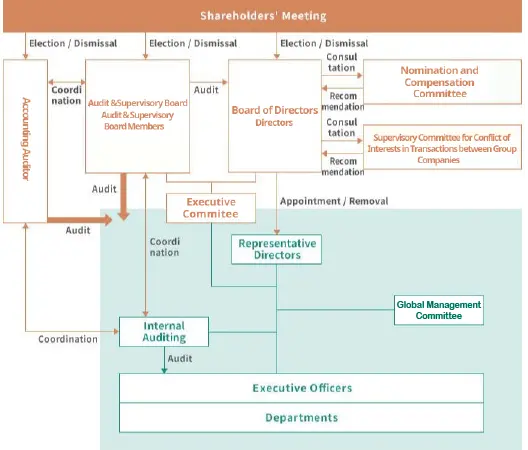
To further strengthen corporate governance, the Company transitioned from a Company with an Audit and Supervisory Board to a Company with an Audit and Supervisory Committee following approval at the Annual Shareholders’ Meeting held on June 26, 2025. Through this transition, the Company has enhanced the oversight function of the Board of Directors, promoted timely decision-making under appropriate oversight, and enriched medium- to long-term strategic discussions.
Board of Directors
The Board of Directors consists of ten members (including one female Director), including five Independent Outside Directors (the chairperson: President and CEO). The Board of Directors meets once a month, in principle, and resolves on or receives reports on material business matters (21 meetings were held in fiscal 2025: The attendance rate of the Outside Directors was 96%). The Company has adopted an executive officer system to separate management supervision from business execution.
Audit and Supervisory Committee
The Audit and Supervisory Committee consists of four members (including one female Director), including three Independent Outside Directors (the chairperson: Full-time Audit and Supervisory Committee Member). The Audit and Supervisory Committee meets once a month, in principle, discusses and resolves material matters relating to auditing, and also examines in advance matters to be submitted to the Board of Directors for discussion. In fiscal 2025, prior to the Company's transition from a Company with an Audit and Supervisory Board to a Company with an Audit and Supervisory Committee, the Audit and Supervisory Board held three meetings, and following the transition, the Audit and Supervisory Committee held ten meetings.
The Audit and Supervisory Committee determines audit policies, audit plans, and the allocation of responsibilities among its members. It also reviews and monitors key audit matters, the status of the audit environment, the development and operation of the internal control system, the appropriateness of audits conducted by the Independent Auditor and its reappointment, transactions involving conflicts of interest or competition, and the Company's response to misconduct and other significant issues.
In addition, the Audit and Supervisory Committee receives reports on audit plans and audit results from the internal auditing function, and where necessary, may request investigations or provide specific instructions to the department in charge of Internal Auditing.
Nomination and Compensation Committee
The Company has established the Nomination and Compensation Committee as a consultative body to the Board of Directors or a decision-making body for matters delegated by the Board of Directors. The Committee is designed to enhance the objectivity and independence of the Board's functions relating to the nomination of Director candidates and the determination of remuneration for Directors (excluding Directors who are Audit and Supervisory Committee Members), and meets as necessary. The Committee consists of seven members, including the President and CEO. To ensure a high degree of independence, a majority of its members (five of the seven) are Independent Outside Directors, and the chairperson is selected by the Board of Directors from among the Independent Outside Directors. In fiscal 2025, the Committee held eight meetings, and the attendance rate of the Outside Directors was 92%.
Supervisory Committee for Conflict of Interests in Transactions between Group Companies
The Company has established the Supervisory Committee for Conflict of Interests in Transactions between Group Companies as a consultative body to the Board of Directors. The Committee helps ensure the fairness and reasonableness of significant transactions with the parent company and other group companies and contributes to the protection of the interests of the Company's minority shareholders. The Committee meets as necessary. The Committee consists of all the Independent Outside Directors, and the chairperson is elected by and from among the members.
Global Management Committee and Executive Committee
The Global Management Committee meets twice a month, in principle, as a consultative body to the President and CEO for decision-making on important business matters based on the basic policy determined by the Board of Directors.
In addition, the Executive Committee meets once a month, in principle, to facilitate the appropriate sharing of information on business execution and other material business matters among Directors, including Outside Directors, Executive Officers, and other relevant personnel.
Accounting Auditor
The Company's accounting audits are conducted by KPMG AZSA LLC under the audit agreement.
Internal Audit
The Company has established the Internal Auditing department, which reports directly to the President and CEO. To support the effective achievement of the Company's management objectives, the Internal Auditing department conducts independent and objective audits of the Company and its subsidiaries, assessing the fundamental elements necessary for achieving the objectives of internal control from the perspectives of legality and reasonableness. In addition, the department evaluates the development and operational effectiveness of internal control over financial reporting in accordance with the Financial Instruments and Exchange Act.
Framework of the Corporate Governance System
Skill Sets for Directors and Skills Matrix
The knowledge, experience and skills to be held by the Board of Directors (Skill Sets for Directors), as determined by the Board of Directors, and the Skills Matrix of the current Directors are available on Skill Sets for Directors and Skills Matrix.
Development of an Internal Control System
The Board of Directors has adopted the basic policies for the development of a system to ensure the appropriateness of business operations. The status of implementation efforts pursuant to the basic policies for each year is reported based on the Companies Act at the Board of Directors meeting held in the last month of the fiscal year and the basic policies are revised as necessary to improve the system.